Note: in addition to the, uh, additional information I tacked onto the end of this write-up in 2025 to freshen it up for recording as an episode of my podcast, I also made a few edits to the body of the original text, mostly to add information I thought would be helpful for anyone who linked here from the podcast who wasn’t already familiar with the big, beautiful, bizarre world of fourteenering. If anyone is curious about the original write-up, I have that version downloaded and saved; PM me if you’d like it for comparative purposes.
I knew I wasn’t totally done with rockfall on Colorado’s fourteeners, but after I’d survived Little Bear, I hoped I’d seen the worst of it and the rest would be smooth sailing well over my head.
But mountains, of course, care little for one’s hopes, dreams, and aspirations. A preceding week that saw me summit Teakettle (so much for avoiding rocks, though in fairness, that peak tops out nearly 200 feet short of 14k) gave me the kind of confidence that oozes over into cockiness, however, and when TallGrass offered to help me make some badly-needed improvements to my climbing skills by taking on the El Diente-Wilson traverse, I accepted without hesitation.
Alas, like a first-time hot-dog eating contestant who doesn’t realize there’s more to winning the competition than possessing a passion for questionably sourced meat, our ambitions outpaced our abilities on that particular day, and we really should’ve realized it when we left Denver at 11 p.m. on Friday night after having spent most of the day sleeping off the previous day’s exploits of a multi-peak loop that had tickled TallGrass’ fancy of thirteeners Argentine, McClellan, Edwards, then fourteeners Grays and Torreys (he did Torreys solo). I’m not sure I even made it as far as Johnson Village on Highway 285 before my eyes elected to go their separate ways, and when my partner pulled over somewhere west of Gunnison and announced that he too needed a nap, the tiny glory-thirsting part of my brain that shouted, “You’ve gotten enough sleep! You can get us the rest of the way!” quickly succumbed to the rest of my brain drowsing out an “Okay!” as I happily reclined the passenger seat as far back as it would go.
I was able to take over only an hour or two later after waking up from a nightmare in which my mother (already deceased IRL) and my dog (I’m allergic to the whole species IRL) were doomed to crumble into the earth each day because they had tasted the refreshments of the Sand Fae, according to the gorgeous woman offering me coffee shortly before dawn. I tried not to consider the implications of what my subconscious seemed to be hinting about being lured into gritty terrain by someone more conventionally attractive than I am as my tall, thin, birth-gender-conforming buddy took his own turn reclining in the passenger seat.
Yet another seat swap when my eyes once again took divergent paths near Ridgway secured our 9:30 a.m. start time, but I wasn’t deterred; the National Weather Service had promised a full day of sunshine, and the Kilpacker trail up to treeline is quite pleasant. Even the rock-laden course after that is well-laid and mostly easy to follow – all my praises to the Colorado Fourteeners Initiative for what I assume was their fine work here!

They clearly figured on letting some of nature remain fully natural once the paths for El Diente and Mt. Wilson split, however, but even then, I saw no reason to worry. Of course the rock was loose, but compared to Teakettle’s sandy flanks – which were bad enough that they had inspired me to channel my inner Shakespeare and coin the term “gravalanche” to describe them properly – this was the 101 class. I didn’t even give much though to descending climbers’ words of warning regarding a sizable rockslide they’d heard someone set off along the traverse, which had scared at least one of them away from even attempting it!
It wasn’t until we were joined by fellow late-starters that we ran into complications. Not from the route itself, though the ease with which we were able to follow a well-cairned track on the way down compared to…whatever we did going up leads me to believe that I may have led us to Choose Your Own Adventure territory, but from our companions, who decided that my partner’s line up to the ridge looked preferable to my own, despite mine being less steep and me thus being able to move more quickly, and so asked him if he wouldn’t mind moving out of their way so they could pass.
He did, in the only way he could: by reaching the top of the gully. We may have exchanged a quiet snicker as we began working our way over to the summit over their nerve – where *had* they expected to pass him, anyway? There’d been maybe 2-3′ of room to his left, maybe! Anyway, it was already mid-afternoon, possibly even sliding into late afternoon…what kind of rush were they in?
I probably would have forgotten all about them as I let TallGrass – who had climbed this peak before, even if he’d approached it via the North Buttress that time – take lead on the final series of scrambles up to the summit, heeding his advice to hang back at the base of the short gullies on which gravity-chasing stones were inevitable. When it was my turn to ascend the last of them, I must’ve set off a pebble of my own, one so seemingly inconsequential that I didn’t feel or hear it slide out once my foot gave it leave. I’m surprised I didn’t immediately flinch backward into the void myself from the shock of hearing “OW!” screamed from what sounded like directly below my shoulder, followed by a lecture about the importance of calling out whenever a rock goes flying.
I feel fairly confident that I stammered out something more polite than, “I’m sorry, I didn’t know this was the Iditarod and that you needed to have your nose up my rear end the whole way!” but to judge from the invective I got in response about how I ALWAYS needed to declare my rocks, no matter how minuscule and how likely they were to stop before hitting somebody if the somebody in question had employed a little common sense and started up a steep scree slope sometime after the person ahead of them had exited it…or perhaps I once again channeled my inner Shakespeare and added the last clause on my own. At least they were kinder enough to give me more room for the last few feet to the summit, and TallGrass and I made sure to let them have a good head start on their way down so that they could make whichever Guinness record they were obviously trying to set that day.

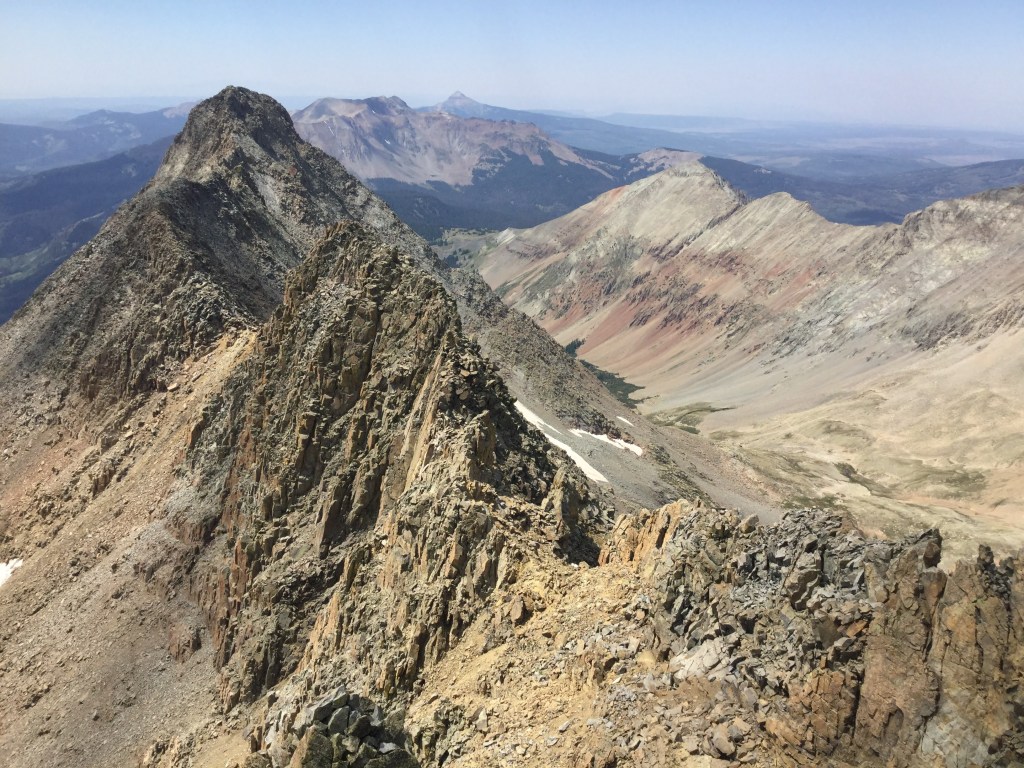
I’d been on the fence about doing the traverse from the time we summited – it was after 4 p.m., I was pre-loaded with fatigue from the week’s prior exploits, and wow did that connecting ridge look long and gnarly – but I did perk up a little when we made it back to the top of the Gray Gully that marked our decision point in what was a record descent time for me. TallGrass, however, expressed his concern about the possibility of climbing the Class 4 headwall in the dark, and whether we’d have wound up using the ropes we’d brought specifically for it or not, I shared his reluctance. Mt. Wilson would have to wait for another day.
It would wind up having to wait for more than a month and a partner for whom the higher Wilson would also be a new ascent. This time, we started at 5 a.m., even though we had no intention of tackling the traverse: I consider them means to an end and am more concerned with the peaks themselves than how I ascend/connect them; bosnian2014, like me, prefers a less-grueling hiking pace. The trail nevertheless faded into the background soon enough, as did the rocky basin leading up to the lingering snowfields. We blundered our way past one on what we would confirm 100% on the descent was the wrong side to take – climber’s left is narrow and sloppy, but the slope to climber’s right, while loose, does offer more room to work with.

We played hopscotch with the boulders beside and even embedded in subsequent snowfields. We paused for a break around 13,500′, shortly before the highest of them fizzled out beneath a layer cake of scree and intimidatingly vertical rock bands. I glanced at the helmet attached to my pack as I put my water bottle away. “Think we should put these on here, or can we get away with waiting until we’re a little higher up?”
My partner glanced at the boulders surrounding us, most of which had been sturdy, but a few of which had wobbled beneath our feet. “Anywhere the rock is loose, it’s probably a good idea to put on a helmet.”
I groused about how I was already sweating profusely, though I removed the helmet from my pack and put it on just the same. I gave more thought to the obstacles I couldn’t see yet than the ones right beneath my hands and feet – the gully crossover in the route description seemed like it ought to be easy to identify, but I’d screwed up on lesser routes! – and so it almost didn’t register when I heard a sound akin to leaded glass shattering and scattering in an echo chamber: rockslide.
My head reflexively turned back behind me, where the sound had come from. No way it could be my partner, though, I tried to tell myself. We’d heard a rockslide go from evidently natural causes from a gully opposite El Diente that morning; surely this was just another natural rockslide, one a lot closer! I called my partner’s name, but got no immediate response.
Two other climbers who had caught up to and passed us with appropriate distance and technique had a better vantage than I did at that point. “Looks like he might’ve twisted his leg,” one of them softly told me.
My partner yelled my name out as the other climber’s words pushed me back to reality and I combined speed and caution as best I could while I scurried back down to his position. His face was bruised, and he was testing his limbs slowly.
As I ran through what I remembered from First Aid training and tried to figure out how I was going to carry him off this mountain if he had, in fact, twisted his leg, he explained that a rock near the “trail,” which was loose dirt where he’d been, had given way. He’d fallen and flipped twice, hitting his head the first time he’d landed…but fortunately, we’d both put our helmets on at that last break not ten minutes before.
I helped him find his phone and retrieve the bottom part of his trekking pole, which had continued downward another few feet. We took another pause while he drank some water, concluded that the physical damage he’d suffered had been merely surface wounds, and so considered whether to turn around then and there, whether to let me go on to the summit while he waited there, or whether to go on himself.

He eventually decided on the third option, with me leading the way and cautioning him on where to wait so I wouldn’t accidentally attack him with still more rocks, as the entire top layer of this particular peak seemed to be potentially mobile. After a few pauses to catch our breath and, in one case, so that my partner could give a brief rundown of why a descending climber who’d come off the traverse would be best served putting his helmet back on, we made the summit.

Just as on neighboring El D., my partner and I gave our summitmates plenty of time to clear the final pitch before we started down. I was pleased that we mostly managed to stay on our feet in spite of how steep and loose the uppermost 500 vertical feet are; it may have been mild compared to certain more-technically-challenging Centennials in the near vicinity, but it was obnoxious nonetheless.
I breathed a little easier when the lowest gully receded into the top of the boulderfield, though it was understandable that my partner did not. I relaxed even more when we once again had something resembling a trail, or at least a well-trod path, though it wouldn’t be too long before the junction with the slopes leading up to El Diente that I would start cursing the rocks piled all the way between my feet and treeline for their continued existence. Even once back below the trees and on real trail, I had fault to find; there should never be that much *up*hill on the descent!

Still, it had to end eventually, and eventually, it did. And while I know all too well that Mt. Wilson will not be my last Too-Close Encounter of the Rocky Kind, I can at least be grateful that to my knowledge, no one was irreparably harmed during unplanned demonstrations of lessons in not hounding one’s fellow climbers in loose terrain and the importance of wearing a helmet in the same.
Afterword of sorts from nearly five years later
I feel like I’ve somewhat exhausted the whole ABC After School Special Lessons Learned when it comes to the more recent trip reports in particular, seeing as how many of them either had that baked into the initial writing or were so cringeworthily flirting with disaster even at the time that the lessons should have been obvious (at the least, to everyone else, if not to me).
Instead, or perhaps in addition?, to that, I might as well continue taking full advantage of having several years to reflect since the time of the initial writing to add any additional thoughts that might have percolated through following the climb and first publication.
In the case of El Diente and Mt. Wilson, my additional thoughts are that I didn’t particularly care for either in the immediate aftermath of climbing them…but that while I still have no interest in repeating them almost five years afterward, subsequent fourteeners would help me begrudgingly mentally uproot these from really, really close to the bottom of my Favorite Fourteeners List to the point where they are no longer even in the Bottom Ten. Bottom Twenty, even Fifteen, absolutely – solidly in the Never Again category, to be certain – but yet another loose pile or two of garbage rock on which someone logged a minor injury, perhaps only to the ego? Eh, after a certain point, that kind of got to be just another day in the mountains for me.
But I suppose all this lofty talk of moving past lessons learned might indicate that I have given no more thought to the rock-, or rather, pebble-fall incident in which some of the small rubble I dislodged on El Diente hit a following climber in the face. In point of fact, I have given that unfortunate incident quite a bit of thought in the years since…and become even more convinced that the climber as well as her partner right below me were the ones who hopefully learned a lesson, since they were more in need.
After all, a LOT – and the all caps were necessary, I feel – of Colorado’s fourteeners are loose in places. The ones that don’t seem to be most likely only seem that way because a given trail up them is so solid and well-established that any garbage rock has long since been conveniently shunted off to the side, out of sight and out of mind as far as those willing and able to stick to the trail are concerned.
For ones that don’t have trails, however, it’s just safest to assume that you will be knocking something loose at some point. If it’s a particularly big “something” or it’s guaranteed to fall for a great enough distance that it could cause a worrisome injury – if, say, it’s coming from somewhere above Little Bear’s Hourglass down into that feature – then of course one should take loud and urgent action to alert any climbers below so that they might hopefully be able to dodge it in time.
But some routes are so loose, especially where a gully is part of the standard path, that if one were to call out “Rock!” every time they sent small fragments downward, they might well be yelling with every movement of a hand or foot. And while there are certainly actions climbers themselves can take to ensure these small fragments only fall their typical few feet before coming to a stop, such as spacing out in such a way as to minimize the effects on those surrounding when possible, it’s also on them to be continuously aware of those surroundings – including what’s happening above them.
In short, standing directly below a climber who is ascending what is known, especially by that point in the given climb, to be a loose pile of garbage is a) highly unlikely to make the climber you are none too subtly hinting about the geologic nature of their pace miraculously able to go any faster and b) highly likely to ensure that you wind up with some of that loose garbage in your face. I highly encourage other climbers to revive at least one COVID convention that seems to have faded since the advent of the vaccines and available treatments: social distancing. Maintaining a six-foot personal bubble on the mountain is excellent for encouraging goodwill and discouraging the exchange of rocks as well as cooties!
And with that joking-but-also-kinda-not Hope SOMEONE Learned a Lesson, let me at least briefly call back to my facetious Lessons Learned and Generally Not Applied to Myself from earlier podcasts as well as tying back (that is going to be funny to me, at any rate, by the end of the sentence) to my last episode about my brief-for-a-reason attempt at being a Real Climber(™), with ropes and harnesses and everything, particularly the end of the episode, in which I mentioned that my once-and-apparently-wanted-to-be-future partner in crime…er, climb TallGrass had apparently convinced himself that I totally wanted him to take me back to the scene of an early climbing crime so that I could “do it clean,” and I told him that doing it again was not an interest of mine and doing it clean was almost certainly still not in my skillset, only I did so less succinctly and more profanely.
Because I believe it was sometime around that conversation that TallGrass also tried to get me to come along on his self-appointed mission to ascend a 14k’ subpeak that had only recently been granted its loftier status thanks to LiDAR (the same advanced surveying technique that had kicked the so-called Centennial thirteeners he’d pulled me up off the Hundred Highest list and thus pushed me over the thankfully-only-metaphorical edge of disgust with pursuing the non-fourteener list of Colorado’s Top 100). This subpeak – a.k.a., bump on a larger mountain’s shoulder only of interest to the most…dedicated of peakbaggers – is on the ridge Wilson and El Diente share, so I can only imagine that TallGrass thought he was really throwing a tantalizing offer at me by telling me that if I went with him, we could pick up the El D.-Wilson Traverse where we’d left off back in 2020, thus essentially completing it a mere three years later.
I’m sure my response to this had just as many profanities as my answer to his offer to repeat Teakettle with me. I might have had something more closely resembling an actual explanation as to why I had no interest on hand than I did for the Teakettle offer: as evidenced by the second half of the initial trip report, I had already climbed Mt. Wilson by that point (in fact, it was the other Wilson – the Peak – that I needed, which was, in a roundabout way, how this conversation took place to begin with: we were carpooling to the San Juans so that he could get his subpeak and I could attempt neighboring Wilson Peak, although I actually wound up not feeling up to the attempt by the time we reached the trailhead and so spent the day napping and playing games on my phone while he went after his subpeak), and even if I had still needed the taller Wilson, why would I make summiting it harder on myself by doing the more complicated traverse when I could just take the standard-for-a-reason route?
That might have finally gotten it to sink in for TG as well as myself once and for all that I am a hiker, not a climber, and that unlike a lot of the fourteener enthusiasts who do take an interest in adding onto the their outdoors resumes, I’m really not interested in making the crossover…or the traverse.
But of course one can take from the fact that this particular “no, but thanks for asking, I guess?” took place in 2023 and that I might very well have taken him up on it or the similarly-timed Teakettle one had he tossed either out early enough in 2021 or maybe even sometime in 2022 with the right framing that I still had a while to go before I would truly learn my lessons, facetious and otherwise…and since I still had Colorado’s allegedly hardest fourteener still left on my list in August 2020, I had plenty of time and opportunities left to start learning.
 Of Mice and Mountaineers
Leave a comment